
How dock shelters improve loading dock performance
A well-designed loading bay is not just an access point, it is a controlled transition zone. When properly installed, loading bay shelters reduce thermal disruption, stabilize internal conditions and protect goods during transfer.
In this context, a dock door shelter acts as a flexible sealing element that adapts to different vehicle sizes while maintaining partial or full enclosure during docking. This improves energy efficiency and reduces exposure to external conditions such as wind, rain or dust.

Energy savings
Significant reduction of thermal losses in temperature-controlled warehouses.
Industrial hygiene
Effective barrier against dust, insects and external particles
Workplace ergonomics
Improved climatic conditions for operators.
Asset protection
Prevention of damage to goods caused by humidity or rain.
Loading dock shelters best practices
Types of dock shelters for loading docks
Selecting the right technology depends on the temperature differential and frequency of use at each industrial loading bay.


Why choose alapont global
Alapont Global develops industrial access systems for demanding logistics environments. As established dock shelters manufacturers, they deliver robust, customized sealing solutions for complex operations.
Guaranteed ROI
Recover the investment through immediate energy savings.
Technical support
Expert guidance to choose the right model for your operation.
Industrial robustness
High-resistance materials such as galvanized steel and PVC.
Full adaptability
Custom manufacturing for complex and specific logistics projects.

How to choose the right dock shelter
Analyzing the operating environment variables ensures a profitable and durable investment over time for any industrial insulation solution.
01.
Temperature difference
Determine whether the thermal gap requires an inflatable or retractable model.
02.
Fleet type
Assess whether you handle vans, standard trucks or large trailers.
03.
Frequency of use
Evaluate whether goods traffic is intensive in order to prioritize retraction speed.
04.
Building location
Consider exposure to wind and rain when designing the upper drainage system.
Safety and applicable atandards for loading dock shelters
Safety at loading bays is a critical factor in ensuring operator protection and operational continuity. Below are the key regulatory requirements and essential safety systems:
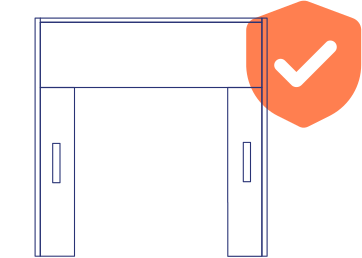
We develop features such as anti-slip surfaces and side protection systems to minimise risks, ensuring a safe and efficient working environment.
Download our catalog
Access all the technical and visual information on our solutions to optimise your loading area with Alapont Global.

Frequently asked questions about loading dock shelters
What type of dock shelter or dock seal do I need for my loading dock?
It depends on the type of vehicles, frequency of use, required sealing performance and installation conditions.
What dimensions should be considered before choosing one?
You should assess the width and height of the opening, dock projection, the usual truck dimensions and the type of vehicle approach.
Can it be installed on an existing loading dock?
Yes, in many cases it can be installed on existing docks without the need to rebuild the entire installation.
Is civil work required for installation?
It normally does not require major civil works, although fixing and adaptation work may be needed depending on the dock.
What service life does a dock shelter have?
Its durability depends on the intensity of use, the quality of the materials and maintenance, but it is designed for continuous use in industrial environments.
Is it suitable for intensive use?
Yes, provided that a model designed for high traffic and demanding logistics operations is selected.
Is it suitable for the food industry, logistics or cold storage?
Yes, it is a widely used solution in these sectors because it helps improve insulation, hygiene and environmental control.
Does it help save energy in the warehouse?
Yes, by reducing the infiltration of outside air, it helps improve the building’s energy efficiency.
Is it compatible with sectional doors and dock levelers?
Yes, it is designed to integrate with the other standard components of a loading dock.
What happens if the fleet includes trucks of different heights?
In that case, it is advisable to choose a solution offering greater adaptability to different vehicle sizes.
How does it improve loading dock safety?
It improves safety by better protecting the loading area and creating a more controlled and protected manoeuvring environment against outside conditions.
Which solution is best suited to my operation?
The best solution is the one that matches your fleet type, frequency of use, required insulation level and the specific conditions of your loading dock.
Tell us about your project and we will help you
We help you choose the loading dock shelters for your project.
Request a call
and we will contact you as soon as possible.
