
Operational benefits of industrial platforms
Installing industrial goods lifting platforms has a direct impact on warehouse profitability. By managing loads vertically, you increase productivity and eliminate bottlenecks in factories or distribution centers.
Our units feature a reinforced structure designed for intensive use, ensuring cargo protection and superior ergonomics in every cycle.

Agile logistics flow
Streamline the movement of goods between floors.
Industrial ergonomics
Reduce physical effort and the risk of injury.
Dock efficiency
Optimise goods loading and unloading times.
industrial lifting platforms best practices
Types of industrial lifting platforms
Discover the options available for your facility, from single-column systems to bespoke industrial goods lifting platforms designed to maximize your operational footprint.


Why choose Alapont Global
As specialist manufacturers, we combine engineering, in-house production, and experience to develop safe, reliable industrial goods lifting platforms tailored to each logistics flow.
In-house manufacturing
Factory-direct solutions adapted to your actual needs.
Certified safety
Strict compliance with the European directive and national standards.
Minimal civil works
Fast installations that minimise alterations to your infrastructure.
High durability
Resistant materials designed to withstand loads of up to 10,000 kg.
Technical advice
Expert support to help you choose the most efficient platform.

How to choose an industrial lift platform
Assess these critical factors before making your technical investment:
01.
Load capacity
Define the maximum weight, including manual or electric handling equipment.
02.
Lifting height
Measure the exact vertical travel between the required stop levels.
03.
Available space
Consider the pit dimensions and floor surface area for integration.
04.
Working environment
Assess whether you need special treatments against moisture or corrosion.
Safety and regulatory compliance
Industrial safety is a priority for any lift platform at a loading dock. Our platforms comply with European Directive 98/371/EC, ensuring that every loading and unloading operation is reliable.
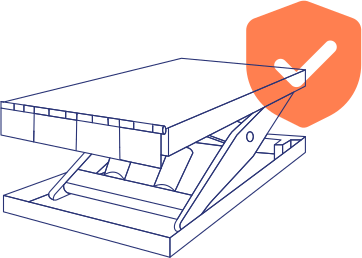
Implementing these systems in accordance with industrial safety regulations reduces occupational risks and ensures legal compliance in your technical installation.
Download our catalog
Access all the technical and visual information on our solutions to optimise your loading area with Alapont Global.

Frequently asked questions about industrial platforms
What specific application do I need the platform for?
The first step is to define its exact function, because a platform for loading and unloading is not the same as one intended for access, maintenance, working at height or supporting goods handling. The application determines the design, capacity, safety features and the most suitable type of installation.
What load must it support?
The platform must be selected according to the actual working load, taking into account operators, tools, goods, pallet trucks, forklifts or any other equipment that will be used on it. For lifting equipment and work platforms, the maximum working load must be clearly defined and always respected during operation.
What dimensions do I need?
The dimensions depend on the available space and the intended use, so width, length, useful height, travel or operating surface should be defined before choosing the model. In load platforms, the space required for access manoeuvres and safe circulation must also be considered.
Do I need it fixed or mobile?
It depends on whether the platform will always operate at a specific point or whether you need to move it between different areas of the warehouse or industrial facility. Mobile solutions provide flexibility and make it possible to create work or loading points where there is no fixed infrastructure.
What standards or certifications must it have?
The applicable standard depends on the type of platform. A load platform is not the same as a lifting platform for people. In the case of mobile elevating work platforms, for example, reference is commonly made to EN 280 and to specific safety, training and use requirements.
Can it be installed in an existing building or area?
Yes, in many cases it can be implemented in existing facilities, provided that the space, support structure and conditions of use allow correct installation and operation. This is one of the advantages often highlighted by manufacturers of portable platforms and mobile ramps.
What service life can it have?
Service life depends on the material, design, load level, environment and maintenance carried out. Under suitable conditions and with proper maintenance, an industrial platform can provide long-term service, although its actual durability will depend on intensity of use and exposure to impacts, humidity, outdoor conditions or corrosive agents. This is a technical inference supported by the importance that sources give to materials, strength and maintenance.
Which solution is the most cost-effective for my operation?
The most cost-effective solution will be the one that best suits your actual use, balancing initial investment, installation, maintenance, safety and productivity. In the case of portable loading platforms, for example, manufacturers present them as a flexible alternative for creating work or loading areas without the complexity or cost of permanent fixed infrastructure.
Request a quote
If you want to improve your operation, request your customised quote now. We will help you choose the ideal platform for your business with no obligation.
Request a call
and we will contact you as soon as possible.
