
Having a safe and efficient loading dock is synonymous with guaranteeing productivity and optimization of the loading and unloading processes, avoiding problems in the future that influence the day-to-day running of the company.
To achieve this, we must correctly design the loading and unloading area, taking into account some factors such as the location of the loading dock; the elements that compose it or the need to control the temperature or not, among others.
How to design a safety and efficient loading dock?
Select the proper location
The location of the loading and unloading points is essential for the organization and productivity of the company. They must be located in such a way as to facilitate access and work, while at the same time not hindering other activities.
For this reason, it is recommended to locate the loading area away from other work areas, the warehouse, and personnel access.
Important distances to consider for easy access to the loading dock
If certain important distances are not taken into consideration when designing the loading and unloading areas, the access of goods vehicles will be affected, to the extent that they will not be able to carry out their work.
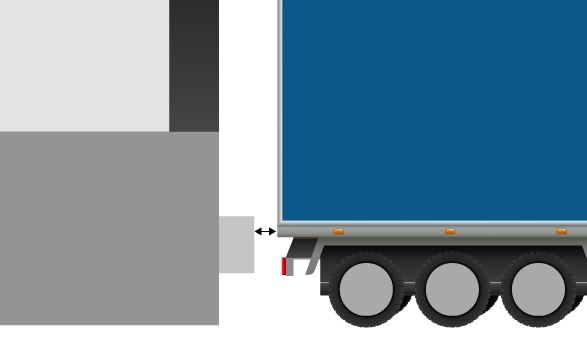
Space between the loading dock and the lorry
In order to facilitate the manoeuvring of trailers, a distance of 32 centimetres is recommended between the loading dock and the truck. This can be reduced by two centimetres if the space between the vehicles is at least 2 metres.
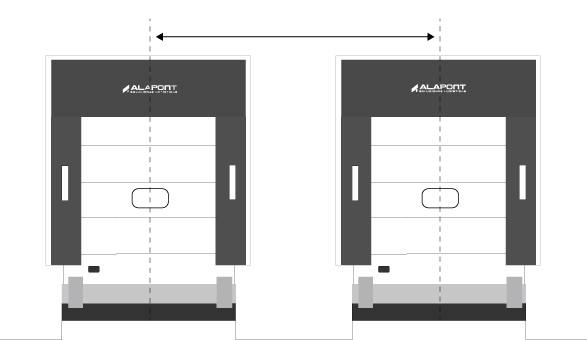
Distance between loading points
There should be a distance of 4 metres between the central axes of two loading and unloading stations. This allows drivers of large trucks to open the doors without any problems.
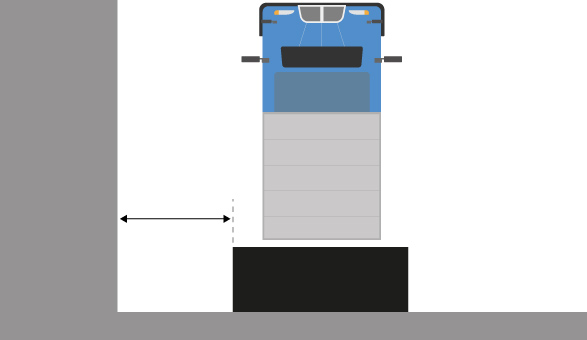
Gap between the last truck and the side wall
There must be a distance of 1.4 metres between the truck and the side wall of the shed to allow the vehicle door to open. This gives a minimum clearance of 2400 mm between the wall and the loading bay door axis.
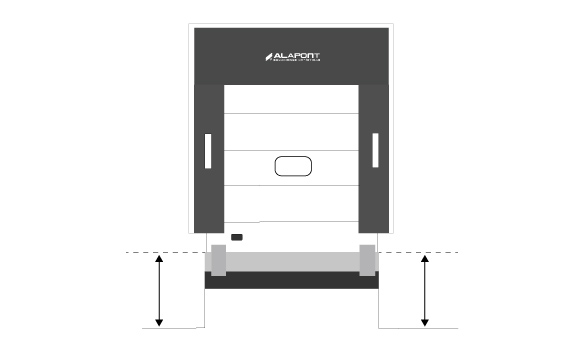
Height between the floor and the loading dock
In most cases, the height of the platform ranges between 1.10 m and 1.20 m. When the warehouse is intended to receive vans or smaller or larger vehicles, it will be necessary to adapt the height of the loading bays with dock levelers.
Choosing the ideal loading dock leveler
The loading dock leveler is one of the most important elements, as a large part of the goods entering and leaving a warehouse passes through it, thus ensuring that the supply chain is not broken.
To find the ideal model of dock leveler, it is necessary to take into account some essential aspects, such as the maximum weight it will have to support, the type of vehicles that will circulate on it or the thermal requirements of the goods to be worked with.
You can opt for the installation of hydraulic dock levelers (hinged lip, vertical, telescopic lip and Smart-Dock) or mechanical levelers (steel or aluminum gangways and mini ramps). Special loading levelers are also available, such as the 12-metre transportable leveler, the isothermal tunnel or made-to-measure levelling leveler.
Sealing system
At Alapont Global we have three models of dock shelters. All of them protect against the cold, wind and heat, but depending on the degree of waterproofing required, one or the other will be recommended.
Retractable dock shelters
When you don’t need to have exhaustive temperature control, the retractable dock shelter is a good option. It fits all types of vehicles and is highly resistant to moisture and abrasion.
Inflatable shelter and inflatable shelter plus
Both the conventional inflatable shelter and the plus model are recommended for installation in areas where the temperature difference between inside and outside is very high, as they are the best ally for achieving sealing.
The standard inflatable shelter is only suitable for trailers and lorries, while the inflatable plus shelter is suitable for all types of transport vehicles.
Complements to increase safety at loading docks
In order to provide greater safety in the loading and unloading area there are different complements such as the lorry restraint, traffic lights or LED lights.
Wheel lock restraint system
The truck restraint is a manual wheel lock restraint system that prevents the vehicle from being moved during the work of the operators. This minimizes the risk of accidents due to lorries moving because they are not immobilized.
Traffic lights
Green and red LED lights indicate to the driver the possibility of manoeuvring during, the loading and unloading of goods.
Led loading dock lights
Having an illuminated loading area will help to avoid accidents caused by lack of lighting. The recommended lighting levels will change depending on where the LED spotlights are to be placed.
At Alapont, our spotlights provide brighter light inside the vehicle, helping to create a safe working environment with minimum energy consumption.
Impact protection accessories
Thanks to protection complements such as bumpers, guide tubes or bollards, the damage caused by impacts from transport vehicles approaching the loading and unloading area can be reduced.
Bumpers
Bumpers are installed with the aim of extending the useful life of the loading dock and the ship itself. The bumpers cushion the impact of the truck when it approaches the platform and avoid collisions with the rest of the elements that make up the dock.
Loading dock wheel guides
They help the driver during the docking of the truck so that it is placed in the correct position. Loading dock wheel guides are installed on each side, in front of the loading dock. Furthermore, they can be open with three supports or straight with two supports.
Bollards
Polyethylene bollards protect doors, walls, and pillars from accidental rubbing during loading and unloading of goods. Failure to have such protection can lead to damage in the future, especially in a warehouse with a lot of logistical movement.
Before designing the loading and unloading area for your business, we recommend that you speak to one of our experts at Alapont Global, who will help you to achieve a safe and efficient loading dock.
