
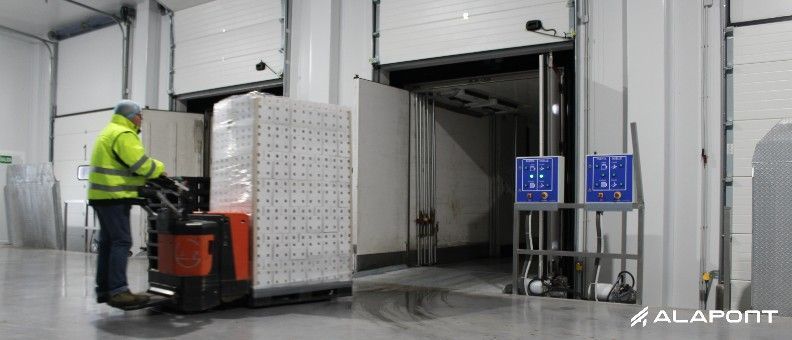
Dock levelers, although robust and durable, can suffer deformations over time if they are not used properly and in accordance with the manufacturer’s recommendations.
Three tips to extend the service life of a dock leveler
Longitudinal Movement
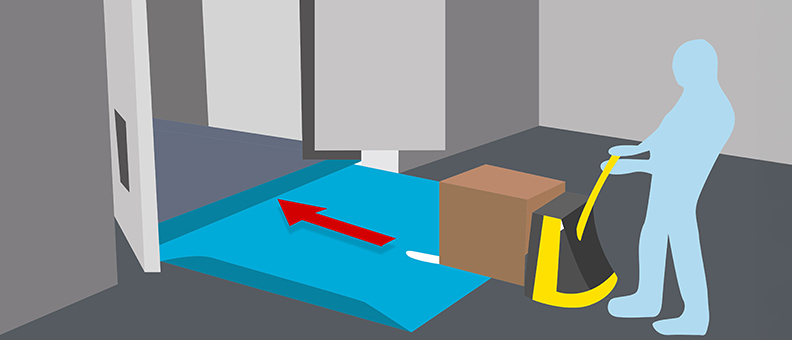
Dock levelers are designed to handle the loading and unloading of goods in the direction of the truck bed — that is, longitudinally rather than transversely. All reinforcements and structural profiles are concentrated and aligned to support forklift traffic in that direction. Therefore, if transverse circulation occurs, the structural profiles are not equipped to handle the load. This can result in the deck plate gradually yielding and deforming as it sinks between the beams, which are not reinforced for such stress.
To avoid these types of deformations and prolong the life of the dock leveler, forklifts should not drive over the platform when it is in the rest position. Occasional crossings are not a problem, but regular misuse can lead to permanent damage.
Deformations are determined by the elastic limit, which is the maximum stress a material can endure without suffering permanent deformation. If the applied stress continues to increase, the material reaches its breaking point.
Appropriate speed
While there are no specific regulations stating the speed at which forklifts should cross the dock leveler, it is recommended to maintain a maximum speed of 10 km/h, with an ideal range between 2 and 5 km/h. The lower the speed, the lower the impact, which in turn helps to extend the product’s lifespan. It is also advisable to reduce speed when entering and exiting the dock leveler.
Dock leveler construction features
There are still dock levelers on the market manufactured using folded L-shaped sheet metal instead of IPN 100 I-beams. Although both models offer resistance, continuous passage of transport vehicles over levelers made with folded sheet metal often results in deformation and warping of the surface.
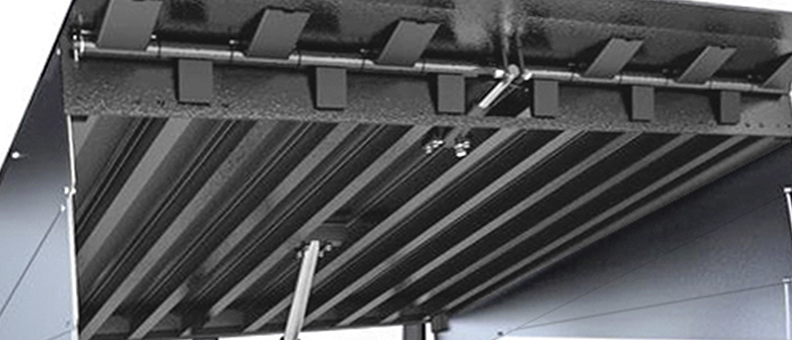
To prevent this, Alapont Global manufactures its dock levelers reinforced with 10 IPN 100 I-beams, ensuring greater load distribution and minimizing deformation.
Study on Dock Leveler Deformation
At Alapont Global, we conducted a study on the deformation experienced by a hinged lip dock leveler under constant load, comparing one of our models to a competitor’s.
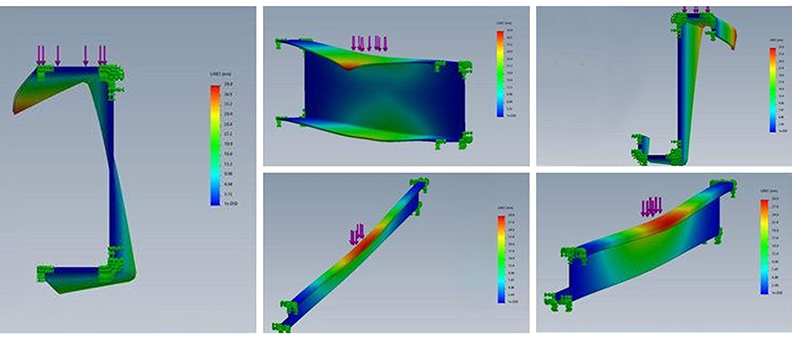
As shown in the image, the competitor’s dock leveler exhibited more deformation than the one manufactured by Alapont. Our T-shaped beams provided greater strength by distributing the stress evenly along the entire length of the beam.
If you want to prevent premature and excessive wear on your dock levelers, proper usage is essential — but so is investing in product quality. For more information about our dock levelers and the features that make them unique in the market, please contact us.
