
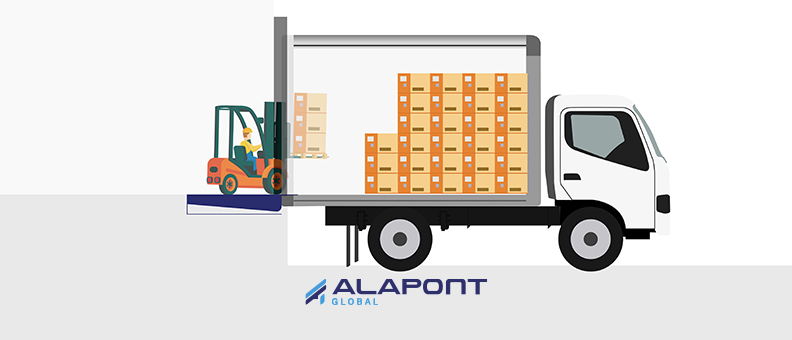
The loading dock is the critical link between the warehouse and external transport, ensuring that the supply chain keeps moving without interruption. However, poor planning can lead to thermal losses, ice formation and safety risks that directly affect operating costs.
Optimising these access points through efficient loading docks is essential to improve productivity and protect both goods and personnel.
What exactly are loading docks and why are they important?
From a technical and functional perspective, a loading dock is the warehouse area designed to carry out loading and unloading operations between the inside of the building and transport vehicles.
Function of the loading area in the logistics chain
Its function is to ensure an efficient, safe and fast transfer of goods, acting as a direct connection point between the warehouse’s internal operations and external transport, and ensuring a continuous product flow.
Importance and impact on operations
The relevance of loading and unloading points has a direct impact on several key performance indicators (KPIs):
- Order processing capacity: Determines how many units can enter or leave the system within a given period.
- Lead time (transit and fulfilment times): An efficient dock reduces the total time a product remains in the chain before reaching the customer.
- Route and transport management efficiency: It facilitates the work of carriers and external logistics planning.
- Operating costs: It influences labour costs associated with loading tasks and the costs arising from material handling.
In high-volume environments, these inefficiencies directly affect profitability and the level of service provided to the customer.
Which components make up efficient loading docks?
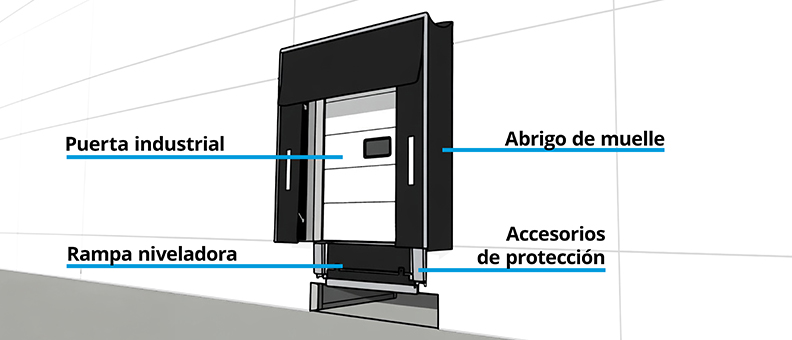
For a dock system to operate correctly, it must be designed as a complete system of elements working in a coordinated way, where each component directly affects safety, productivity and operating costs.
The main elements are:
- Loading dock levellers, which bridge the height difference between the truck and the warehouse and ensure continuous operation with forklifts and pallet trucks.
- Loading dock shelters, which seal the gap between the truck and the building, protecting goods and improving energy efficiency.
- Loading dock truck guides, which enable accurate vehicle positioning and reduce manoeuvring errors and impact risks.
- Loading dock bumpers, which absorb impacts during docking and prevent structural damage to both the dock and the vehicles.
- Loading dock traffic lights, which regulate vehicle entry, exit and positioning, improving safety and operational coordination.
- Overhead sectional doors, which insulate the building, help control indoor conditions and reinforce warehouse security.
Together, these elements determine the operational capacity of the loading area, the reduction of incidents and the durability of the installation in intensive-use environments.

What types of loading docks are available and how to choose according to your operation
The choice of dock type depends on your available space and thermal requirements:
- Recessed dock: The standard industrial option, with the entrance at truck floor level and slightly set back to facilitate drainage.
- Enclosed dock: The truck parks inside the building, providing maximum thermal protection, hygiene and security against theft.
- Sawtooth dock: Ideal when external manoeuvring space is limited, allowing angled parking.
- Ground-level dock: Perfect for heavy and bulky loads or for direct van access.
Dock levellers and solutions for special loads
If precision is your priority, the solution is a dock leveller with telescopic lip, whose extendable lip allows greater flexibility when reaching different vehicle types. In extreme cold environments, the vertical dock leveller allows the building door to close completely in front of the leveller, eliminating thermal bridges.
For optimum sealing, you can choose a retractable dock shelter or, where a higher level of airtightness is required, inflatable dock shelters.
Dimensions and planning of the loading area
Efficient loading docks require a configuration aligned with current logistics technical and regulatory standards. These specifications ensure that the infrastructure is compatible with today’s vehicles and safe for operators.
Distances and spacing between areas
To avoid collision risks and ensure uninterrupted flow of goods, standard dimensions should be respected during the design phase:
- Manoeuvring area (apron): A clear front distance of 32 metres is recommended (30 metres being the absolute minimum) so that trucks can approach safely and in alignment.
- Centre-to-centre spacing: The recommended distance between the centres of two adjacent dock areas is 3.700 mm, although the optimum value to allow comfortable and safe manoeuvring is 4.600 mm.
- Slope of the manoeuvring yard: The approach ground should maintain a controlled slope between 7% and 10% to avoid technical difficulties during vehicle docking.
Loading dock heights according to vehicle type
The alignment between the warehouse floor and the truck bed is a critical safety factor. Below is the technical table showing the recommended dock heights according to the predominant transport type:
| Vehicle type | Body height (m) | Recommended dock height (m) |
|---|---|---|
| Container truck | 1,4 – 1,6 | 1,6 |
| Refrigerated truck | 1,25 – 1,5 | 1,5 |
| Rigid truck | 0,9 – 1,2 | 1,2 |
| Van | 0,5 – 0,75 | 0,75 |
If you need to go deeper into planning, operational safety or specific technical solutions, consult our technical guide to designing efficient loading docks.
In it, you will find key criteria on planning, access points, protection systems, lighting, industrial doors and solutions to ensure efficiency, durability and safety in demanding logistics environments.
Safety and european regulations in industrial loading areas
Regulatory compliance is not optional; it is a critical requirement to ensure operational safety, minimise occupational risks and obtain the mandatory CE marking for loading dock equipment. The key standards in Spain are:
- EN 1398: Regulates dock levellers, requiring anti-slip surfaces, emergency stops and side panels to prevent shearing hazards.
- EN 13241: Regulates industrial doors, requiring the inclusion of safety anti-fall devices and safety edges.
- NTP 1076: Technical note establishing protocols to mitigate trapping, collision and fall risks.
Applying these risk prevention protocols for truck loading and unloading operations ensures compliance with the Occupational Risk Prevention Act (Law 31/1995).
Applicable legislation
Loading and unloading areas must comply with the following legal provisions:
- Law 31/1995: Occupational Risk Prevention.
- Royal Decree 39/1997: Regulation on Prevention Services (amended by Royal Decree 604/2006).
- Royal Decree 486/1997: Health and safety conditions in workplaces.
- Royal Decree 1215/1997: Safe use of work equipment.
Technical standards
- UNE-EN 1398:2010: Dock levellers for loading areas, safety requirements.
- UNE-EN 349:1994+A1:2008: Safety of machinery; minimum gaps to avoid crushing of parts of the human body.
- UNE-EN 13241-1:2004+A1:2011: Industrial and commercial doors.
CE marking and mandatory signage
Each leveller must visibly and legibly display:
- The name and address of the manufacturer or authorised representative.
- Year of manufacture and external power supply data (voltage, frequency, power).
- Maximum leveller capacity and machine designation.
- Serial or manufacturing number.
- The warning “Do not stand under the dock leveller unless it is mechanically locked”, with characters at least 15 mm high.
Risk prevention in loading and unloading operations
Identifying risks makes it possible to implement effective preventive measures to avoid serious workplace accidents.
Preventing premature truck departure
One of the main risks is the fall or overturning of handling equipment caused by unexpected truck movement. To prevent this, vehicle restraint systems are used, such as automatic hooks or mechanical locking systems, which immobilise the vehicle chassis or wheel throughout the entire operation.
Compared with wheel chocks, these systems provide greater safety because they usually incorporate sensors and light signalling to confirm the truck’s safe position.
They allow:
- Blocking the truck during loading or unloading
- Preventing accidental movement
- Reducing human error
- Verifying that the vehicle is correctly positioned
Maintenance and long-term reliability
| Risk | Preventive measures / Maintenance |
|---|---|
| Slips, trips and falls on the same level | Keep all loading dock and vehicle surfaces clean and free of objects before starting any operation. Clean spills immediately. |
| Fall or overturning of handling equipment | Prevent unexpected movement by means of locking systems, avoiding uncoordinated actions between the truck driver and the operator of the loading equipment. |
| Trailer tipping | Check the bearing capacity of the support surface for the trailer supports. Installation of a trailer stabiliser is recommended. |
| Crushing between vehicle and loading dock | Install bumpers with a minimum clear space of 0.50 m. Provide exits, such as stairs between levels, according to the length of the loading and unloading area. |
| Falls from height | Position the truck so as to avoid gaps. Close the loading position when no vehicles are present. |
| Maintenance and reliability of the loading dock leveller | Ensures smooth operation, greater safety for operators and drivers, and extends the service life of all equipment. It is advisable to follow maintenance plans and technical assistance programmes adapted to the installation. |
Frequently asked questions about loading docks
How do I choose the best loading dock for my company?
The choice depends on loading frequency and the type of vehicles used. If you handle a constant and varied flow, the recessed dock is the ideal standard solution; if your priority is the cold chain, the enclosed dock is essential.
How can compatibility with different truck heights be ensured?
Modern loading docks incorporate adjustable levellers that adapt to different vehicle configurations. In extreme cases, variable-height docks or lifts installed directly in the approach area floor can be used.
What maintenance do these systems require?
It is essential to carry out periodic inspections including lubrication of mechanical parts, inspection of hydraulic or pneumatic systems, and verification of the structural integrity of levellers and bumpers.
How does the weather affect dock operations?
Adverse weather conditions can cause slipping hazards or thermal losses. The use of dock shelters and anti-slip flooring helps maintain safety and efficiency in rain or snow conditions.
Is CE marking mandatory on dock levellers?
Yes, each leveller must visibly include the manufacturer’s name, year of manufacture, capacity and the CE marking confirming compliance with European safety directives.
Optimise your loading dock and avoid bottlenecks
The loading dock is the engine of your warehouse. A precise analysis of your needs, together with the right technical equipment, turns this area into a competitive advantage.
Every detail matters: safety, timing and goods flow make the difference.
Contact us and discover the perfect solution for your volume and processes.
