
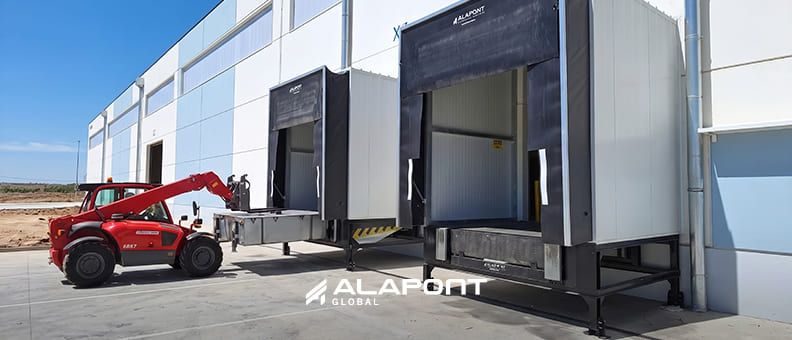
In practical terms, replacing a loading dock means replacing worn, outdated or poorly adjusted equipment with new solutions designed to fit the existing building, dock pit and current operating requirements, especially when those requirements have changed over time. The aim is not to add unnecessary complexity, but to restore performance, safety and operational continuity without the need for civil works.
In this type of project, the objective is for the new equipment to operate within the same dimensions and levels as the existing installation, avoiding on-site adjustments that could extend commissioning times.
Why do loading dock areas become obsolete?
In most facilities, loading docks lose performance not because of their original design, but due to accumulated wear and an increase in operational intensity. Many warehouses were designed for lower volumes than those handled today.
This deterioration leads to clear operational consequences:
- Unscheduled downtime during loading operations
- Loss of consistency in operating cycles
- Increased risk when positioning vehicles
- Higher energy consumption in temperature-controlled areas
- Difficulties maintaining stable conditions in cold rooms or refrigerated areas
When this happens, the equipment stops operating reliably and begins to cause disruptions in day-to-day activity.
How can a loading dock be refurbished without interrupting activity?
In real-life interventions, the critical point is often the dock leveller and the fit between the existing pit and the new equipment. When dimensions do not match current standard models, the usual solution is to manufacture the equipment to measure in order to avoid civil works.
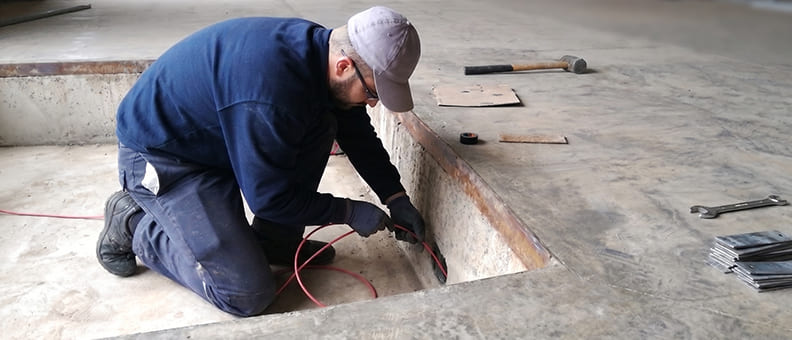
This approach makes it possible to work directly on the existing infrastructure without demolition, concrete extensions or structural alterations.
In practice, a well-planned refurbishment is based on:
- Taking accurate measurements of the existing pit
- Manufacturing the equipment according to those dimensions
- Eliminating on-site adjustments
- Direct installation with no concrete curing time
- Reducing the intervention to a single operational phase
This allows the loading dock to remain operational for most of the process, limiting downtime to the actual replacement phase.
As loading dock equipments manufacturers, we understand that the real value does not lie in adapting the building to the product, but in designing solutions that integrate with the existing infrastructure.
This approach helps optimise costs, reduce operational risks and maximise the overall efficiency of the installation.
What solutions are involved in loading dock refurbishment?
Tailor-made dock levellers
When replacing existing equipment, the first step is to check compatibility with the dock pit. In many cases, dimensional differences prevent standard solutions from being installed without on-site adjustments.
For this reason, tailor-made dock levellers are often used on site, as they respect the existing geometry and avoid structural modifications.
Isothermal dock tunnels
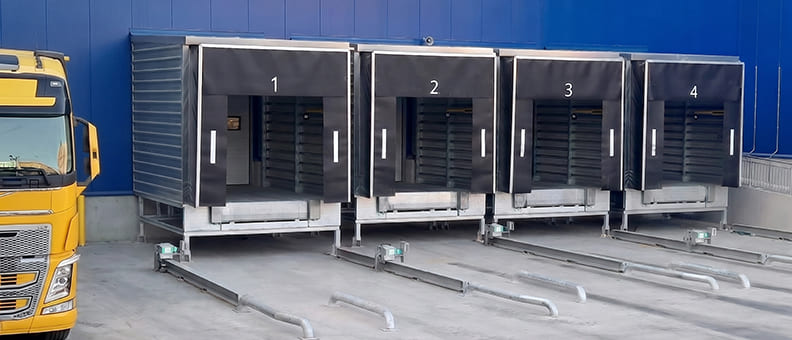
When it is not possible to increase the internal floor area, freestanding loading platforms with isothermal dock tunnels make it possible to create new loading points outside the warehouse.
This solution is especially useful when the building cannot be modified internally or when additional loading capacity is required without stopping operations.
Which elements improve loading dock efficiency?
In a complete refurbishment, dock performance does not depend only on the main item of equipment, but on how the whole system performs under real operating conditions.
Closing and sealing systems are essential for maintaining thermal stability and protecting goods during loading and unloading operations.
- Sectional doors provide high levels of thermal and acoustic insulation, which is essential in temperature-controlled facilities.
- Dock shelters may be retractable or inflatable, helping to improve energy efficiency by minimising temperature loss during operations.
What must loading equipment offer for intensive use?
In loading dock refurbishment projects, the strength and service life of the dock leveller depend largely on the quality of its construction and the components used.
These are some of the usual features found in equipment designed to withstand demanding logistics operations:
| Component | Technical specification | Operational benefit |
|---|---|---|
| Structure | 6/8 mm chequer plate steel with IPN 100 beams | Prevents deformation under heavy loads. |
| Capacity | 9,000 kg static / 6,000 kg dynamic | Supports continuous intensive use. |
| Safety | Hose burst safety valve on the lifting cylinder | Prevents accidental sudden drops. |
| Protection | Watertight IP55 electrical control panel | Full resistance to water and dust. |
Impact of modernisation on operational efficiency
The refurbishment of a loading dock area should form part of a comprehensive and efficient warehouse design strategy, taking into account the actual operation of the facility. A properly executed replacement reduces downtime during the intervention and improves energy performance in areas with continuous activity.
In facilities where the complete system is replaced, the following improvements are usually observed:
- Fewer interruptions during loading cycles
- Greater stability in repetitive manoeuvres
- Reduction of incidents caused by mechanical misalignment
- Improved consistency in day-to-day operations
- Greater predictability in dock performance
The result is an installation that once again operates reliably within the current pace of logistics activity.
Frequently asked questions
How does a well-executed refurbishment improve safety?
Loading dock refurbishment incorporates active safety systems such as auto-levelling, mechanical locking systems and emergency stops. In practice, these elements reduce risks during loading and unloading operations, especially in continuous-use environments. The aim is to minimise human error and stabilise operating cycles in demanding applications.
Can isothermal dock tunnels be installed in any warehouse?
Yes, provided there is external access and the basic structural conditions required for fixing. In real projects, isothermal dock tunnels are especially useful when modifying the inside of the building is not feasible. This makes it possible to increase the number of loading points without internal civil works, while maintaining operational continuity and optimising the available logistics space.
What maintenance do refurbished loading dock areas require?
After a complete replacement, maintenance is based on periodic system inspections and monitoring the wear of moving components. When new equipment is adapted to the existing installation, adjustment intervals tend to be more stable.
Request a quote to modernise your loading dock
When a loading dock loses performance, the most common solution is to replace the equipment that no longer meets the real working conditions of the facility. Based on the dock pit and the level of activity, the most suitable solution can be defined for each installation.
This type of intervention reduces on-site adjustment times and prevents prolonged interruptions to dock operations.
If you need to assess your installation, request a technical study and we will define the most suitable solution for your loading area.
