
Ensuring safety and operational continuity in your facilities is not optional; it is a strategic requirement for your business.
Industrial door maintenance is the foundation that supports the continuity of your logistics chain, preventing critical downtime and ensuring compliance with increasingly demanding technical regulations.
With proper preventive management, you not only protect your workforce, but also optimize the service life of your heaviest assets.
Is industrial door maintenance required by law?
Yes. The obligation is absolute and arises from different legislative frameworks that must be understood in order to avoid penalties and civil or criminal liability. It is not simply a manufacturer’s recommendation, but a legal requirement that applies to both manual and automatic doors.
The spanish legal framework is based on:
- Technical Building Code (CTE): Specifically, document DB-SUA 2, Safety in Use and Accessibility, which requires compliance with specific regulations and CE marking.
- Royal Decree 486/1997: Requires the periodic maintenance of workplace facilities so that they operate according to their intended design and do not affect workers’ health.
- Royal Decree 1215/1997: Requires doors already installed to be adapted to current minimum safety requirements.
Who is legally responsible in the event of an accident?
The legal responsibility for ensuring that industrial doors operate under safe conditions lies directly with the owner or operator of the facility. This means that, in the event of an accident caused by insufficient or non-existent maintenance, the consequences may go far beyond an administrative penalty.
- Civil liability: In accordance with Article 1907 of the Spanish Civil Code, the owner is liable for damage caused by the ruin or poor condition of a building when this is the result of a lack of maintenance or necessary repairs.
- Criminal risk: In workplace environments, if a door failure causes injury to an employee and lack of maintenance or negligence is proven, criminal liability for recklessness may arise, especially if the risk was known and not corrected.
To reduce this risk, it is essential to be able to prove that periodic inspections are carried out by competent personnel. A maintenance contract with a specialized company provides documentary support in the event of inspections or legal proceedings.
In logistics environments, poor management not only involves fines or legal risks, but can also generate operational incidents at the loading dock, leading to the most common loading dock problems, possible stoppages in goods dispatch, and a significant increase in emergency repair costs.
Which elements should be inspected?
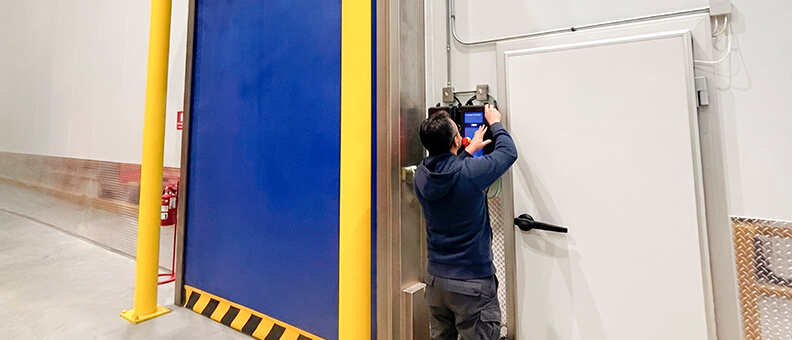
Professional preventive maintenance of industrial doors must ensure the functionality and safety of all components. During the inspection, the technician should focus on:
- Safety systems: Verification of safety photocells and contact safety edges to prevent entrapment.
- Structural elements: Inspection of the steel cable condition and adjustment of tension in the torsion springs.
- Fall protection mechanisms: Checking safety brakes and limit switches.
- Lubrication and adjustments: Greasing of tracks, hinges, and rollers to reduce friction and wear on industrial sectional doors.
- Automation systems: Inspection of control panels and testing of the opening and closing system.
In environments such as cold logistics or the agri-food sector, inspecting automatic high-speed doors is essential to ensure energy savings and smooth traffic flow.
How often should inspections be carried out?
Maintenance frequency depends on the type of door, its use, and the number of daily cycles.
When the manufacturer does not define a specific frequency in the manual, the minimum intervals established in the UNE 85635:2012 standard are used as a reference, in line with Royal Decree 1215/1997 on the use of work equipment.
| Type of use / Door | Usage criteria | Minimum frequency |
|---|---|---|
| Industrial | Standard use, except high-speed doors | Every 6 months |
| High-speed doors | Intensive industrial use | Every 4 months |
| Commercial | > 10 cycles/day | Every 4 months |
| Commercial / Shutters | ≤ 10 cycles/day or rolling shutters | Every 6 or 12 months |
| Garage / Residential | > 50 vehicles | Every 4 months |
| Garage / Residential | 5 to 50 vehicles | Every 6 months |
| Seasonal use | Use during short periods | Every 12 months |
Essential documentation for safe operation
To comply with CE regulations for industrial doors and be prepared for an audit or workplace inspection, you must have:
- Maintenance logbook: All operations, repairs, and replacements must be recorded and signed by the maintenance provider.
- CE marking: The plate must be visible, and the original Declaration of Conformity must be available.
- User manual: Manufacturer’s instructions regarding use and routine maintenance.
Do not forget that sealing performance is also part of safety. Periodically inspect loading dock shelters to protect the goods transfer area.
Frequently asked questions about industrial door maintenance
Is it mandatory to hire an external company?
Although the law requires maintenance to be carried out, a preventive maintenance contract with an authorized company is the document that demonstrates your diligence in the event of an inspection or accident.
What happens if i significantly modify the door?
Any change that alters the characteristics of the door, such as changing the motor type or adding new safety devices, is considered a substantial modification. This legally requires new CE marking for the installation.
Who should carry out maintenance tasks?
The regulations distinguish between basic-level tasks, such as cleaning and visual supervision that may be performed by the user, and advanced-level tasks, which may only be carried out by competent and qualified technical personnel.
What happens if i do not repair a detected deficiency?
If the maintenance provider reports a risk in the inspection report and the owner does not correct it, the owner assumes full legal responsibility for any accident resulting from that lack of safety.
Is any accreditation required to perform maintenance?
Although there is no mandatory official accreditation for industrial door maintenance, the UNE-EN 12635 standard establishes that these tasks must be carried out by personnel with sufficient technical training and experience. For this reason, it is advisable to rely on professionals or companies specialized in automation and industrial systems to ensure the safety and proper operation of the installation.
Protect your operations
A professional maintenance plan not only ensures legal compliance, but also optimizes the service life of your assets and prevents unexpected costs.
Carry out a diagnosis of the condition of your doors and check whether your maintenance plan complies with current safety and regulatory requirements.
