As of 1st November 2017, the applicable regulation for industrial, garage, and commercial doors is UNE-EN 13241:2004+A2:2017, replacing UNE-EN 13241:2004+A1:2011.
This European standard regulates the safety and performance requirements for industrial, garage, and commercial doors, except for fire resistance and smoke control characteristics, which are covered by EN 16034.
What changes does the new regulation introduce?
The new regulation for industrial doors introduces changes affecting the title, scope, and field of application, with the most notable change being that pedestrian doors are no longer covered under this standard, as they now have their own product standard: EN 16361. The other changes are mainly in terminology.
Is it mandatory to adapt automatic doors to safety regulations?
Doors installed after May 2005 should already have all the required safety features, so no further adaptations are generally needed.
However, for doors installed before this date that undergo significant modifications, the answer is yes. They must be equipped with the minimum safety features outlined in UNE-EN 13241:2004+A2:2017, and the installer/manufacturer responsible for the modification must ensure the door is CE marked.
Since May 2005, the following documentation is mandatory:
- Detailed invoice listing the installed elements.
- Identification plate with CE marking affixed to the door.
- Declaration of conformity: stamped and signed.
- User and maintenance manual.
What cases are considered “significant modifications”?
- Changing the mass of the door.
- Modifying the type of door.
- Replacing the motor with a different type.
- Installing new safety devices (e.g., anti-drop, anti-crushing systems).
- Replacing the control panel with a different type.
- Converting a manual door to automatic.
- Replacing or adding any component that could affect safety elements.
CE Marking
The CE Certificate for construction products like commercial doors, garage doors, and industrial gates is essential for selling them in Europe and domestically.
All doors from Alapont Logistics Solutions are CE certified, ensuring their quality and safety in accordance with all regulatory requirements.
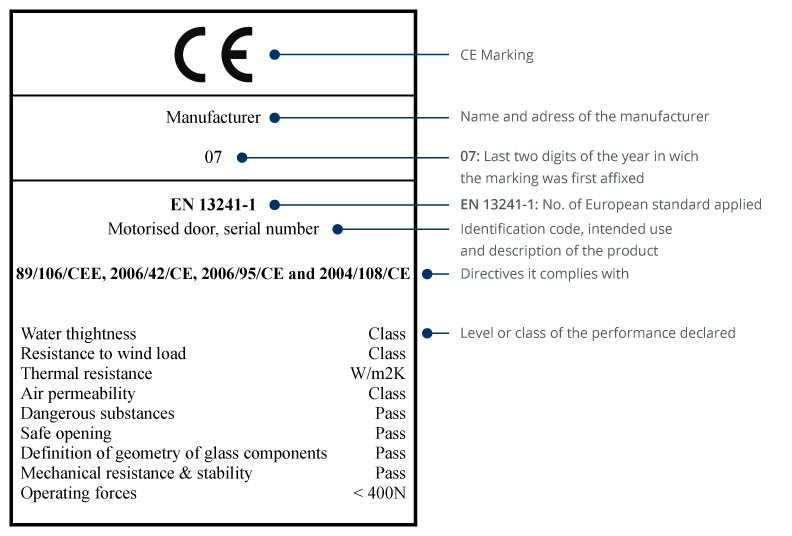
Example of CE marking for a motorised door:
Maintenance of automatic doors
Both garage doors and industrial and commercial doors require mandatory maintenance.
List of European standards applicable to industrial, commercial, garage doors, and gates
In accordance with it, all the following documents must be considered, as they are essential for the correct application of the regulation:
| EN ISO 13850:2015 | Safety of machinery. Functional requirements and design principles for the emergency stop function. |
| EN ISO 14118:2018 | Safety requirements for the means designed to prevent unexpected machine start-up, ensuring intervention in hazardous areas, and including a technical review to improve and expand safety requirements compared to the previous version of the standard. |
| ENV 1991-1-4:2005+A1:2010 – Eurocode 1 | Detailed guidance on determining wind actions for structural design of buildings and civil engineering works. |
| EN 12424-2000 | Industrial, commercial, garage doors, and gates. Wind load resistance. Classification. |
| EN 12425 | Industrial, commercial, garage doors, and gates. Water penetration resistance. Classification. |
| EN 12426 | Industrial, commercial, garage doors, and gates. Air permeability. Classification. |
| EN 12427 | Industrial, commercial, garage doors, and gates. Air permeability. Test methods. |
| EN 12428 | Industrial, commercial, garage doors, and gates. Thermal insulation. Calculation requirements. |
| EN 12433-1 | Industrial, commercial, garage doors, and gates. Terminology. Part 1. Types of doors. |
| EN 12433-2 | Industrial, commercial, garage doors, and gates. Terminology. Part 2: Door components. |
| EN 12444 | Industrial, commercial, garage doors, and gates. Wind load resistance. Tests and calculations. |
| EN 12453:2017 | Safety of motorised doors. Test methods. |
| EN 12453:2017 | Safety of motorised doors. Requirements. |
| EN 12489 | Water penetration resistance. Test method. |
| EN 12604:2017 | Mechanical aspects. Requirements. |
| EN 12605:2000 | Mechanical aspects. Test methods. |
| EN 12635:2002 | Industrial, commercial, garage doors, and gates. Installation and use. |
| EN 12978:2003+A1:2009 | Industrial, commercial, garage doors, and gates. Safety devices for motorised doors and gates. Requirements and test methods. |
| EN 60204-1:2018 | Safety of machinery. Electrical equipment of machines. Part 1: General requirements (IEC 60204-1:1997). |
| EN IEC 61000-6-2:2019 | Electromagnetic compatibility. Part 6-2. Immunity in industrial environments. |
| EN IEC 61000-6-3:2021 | Emission standard for residential, commercial, and light-industrial environments. |
| EN ISO 140-3:1995 | Acoustics. Evaluation of sound insulation for airborne noise of building elements. |
| EN ISO 717-1:2020 | Part 1: Airborne sound insulation |
| EN ISO 12567-1:2010 | Thermal performance of windows and doors. Determination of thermal transmittance by the hot box method. Part 1: Windows and doors. |
Did you find this article interesting? Get all the latest information directly to your email and stay up to date with the regulations by subscribing to our newsletter.