
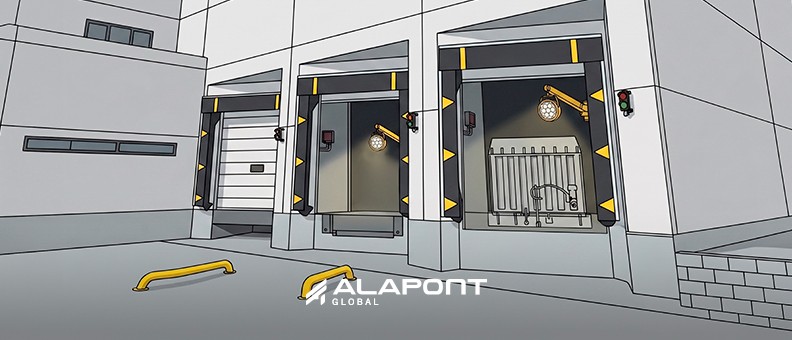
Poor coordination during maneuvers and a lack of clear visual communication between drivers and operators are among the main causes of serious accidents in transfer areas.
By implementing LED visual signaling combined with smart sensors, you eliminate uncertainty during vehicle docking and transform a high-risk area into a safer, more efficient operational flow.
This technology not only protects your team’s physical safety, but also helps ensure compliance with occupational risk prevention requirements in loading and unloading areas.
Why Is Visual Signaling Essential at Loading Docks?
Safety at goods transfer points is critical in any high-volume industrial warehouse. Proper signaling not only helps drivers approach the dock more safely, but also acts as a key preventive measure against serious accidents, such as entrapment between the vehicle and the dock or load falls during operation.
Fewer Errors, Greater Operational Control
A well-designed visual signaling system helps coordinate the flow of trucks and workers more effectively. By eliminating ambiguity in communication between the driver and the operator:
- Maneuvering errors are reduced.
- The risk of collisions or pedestrian accidents decreases.
- Coordination improves at every stage of the docking process.
Standardized Safety in Every Operation
Visual signaling ensures that every movement follows a clear and repeatable protocol. This guarantees that:
- Operations are carried out in an orderly manner.
- Operational exclusion zones are respected.
- Unexpected situations at the dock are minimized.
The Basis of Efficient and Safe Operations
In demanding logistics environments, visibility is not an extra feature; it is an essential element. Proper signaling is the first step toward:
- Improving workplace safety.
- Complying with prevention regulations.
- Increasing efficiency in daily dock operations.
What Components Are Included in a Safety Signaling System?
An effective system must combine lighting and acoustic devices designed to withstand demanding industrial conditions, both indoors and outdoors.

The essential components to integrate include:
- High-visibility traffic lights: Key devices that guide the driver using red and green lights, indicating when it is safe to maneuver or when the vehicle is secured. LED traffic lights for loading areas should provide long-distance visibility, even in adverse weather conditions.
- Articulated work lights: Provide the necessary lighting inside the trailer during loading and unloading, improving accuracy and reducing risks caused by poor visibility.
- Visual positioning guides: Help the driver center the truck at the dock, protecting both the building and the vehicle from unnecessary impacts.
- Detection sensors: Devices such as photocells, proximity sensors and limit switches that monitor the exact position of the truck and the status of dock components.
- Pedestrian warning signs: Specific indicators designed to alert workers to the presence of forklifts or heavy vehicle movements in shared areas.

How Does “Traffic Light Logic” Work in Daily Operations?
The system’s efficiency lies in its ability to operate sequentially, known as “traffic light logic”. This preventive kit is based on a centralized control unit that manages safety through three technical pillars:
- Active detection: A wheel chock with a sensor detects the presence of the truck and prevents accidental departure while operations are in progress.
- Acoustic and visual signaling: The control unit includes sound alarms that immediately warn of incorrect or incompatible maneuvers.
- Safety interlock: The system prevents dangerous actions, such as opening the sectional door if the truck is not correctly docked or if the dock shelter has not been fully deployed.
What Lighting Levels Should Be Maintained at Your Docks?
Lighting intensity is a regulated factor that must be adjusted according to the specific location of each operational area in order to comply with the recommendations of the Spanish National Institute for Safety and Health at Work.
Having the right LED lighting for logistics loading docks helps ensure compliance with the following standards:
| Area of the logistics center | Recommended lighting level (lux) |
|---|---|
| Outdoor circulation areas | 20 lux |
| Maneuvering and parking areas | 100 lux |
| Inside trailers and containers | 100 lux |
| Inside loading tunnels | 150 lux |
| Indoor loading dock area | 200 lux |
Can Signaling Be Integrated with Warehouse Management Systems?
Yes, and this is one of the foundations of Industry 4.0 in logistics. Modern control panels allow visual signaling to be connected with the operation of dock levelers, shelters and doors, automating the entire dock operation process.
How This Integration Works
The system logic ensures that each element operates sequentially and in a controlled manner. For example:
- The door does not open if the truck has not been detected.
- The shelter cannot retract if the dock leveler is not in its resting position.
- Each action depends on validation of the previous status.
What WMS Integration Provides
By integrating these systems with warehouse management software, you gain much more precise and centralized control of the dock:
- Greater operational safety: Incorrect or out-of-sequence maneuvers are prevented.
- More efficient goods flow: Operations follow an automated order.
- Better dock utilization: Waiting times and unnecessary occupation are reduced.
- Real-time data: Useful information for analyzing and improving processes.
How Do Proximity Sensors Improve Maneuvering Efficiency?
Proximity sensors and photocells remove the need for manual signals and reduce dependence on the driver’s mirrors.
These systems measure the distance between the rear of the truck and the dock, sending real-time information to the traffic lights.
This results in faster, safer and more precise maneuvers.
Direct Operational Benefits
- Fewer approach errors: The driver receives clear signals without manual interpretation.
- Greater infrastructure protection: Impacts against dock bumpers and dock structures are reduced.
- Less equipment wear: Impacts and constant adjustments in the loading area are minimized.
Automatic Lighting and Efficiency
Work lights are activated automatically when movement is detected or when the dock door opens. This enables:
- Immediate lighting only when needed.
- Greater visibility for the operator inside the trailer.
- Reduced energy consumption within the facility.
Frequently Asked Questions About Visual Signaling at Loading Docks
Can These Systems Withstand Weather Conditions and Intensive Industrial Use?
Yes. The equipment is manufactured using materials such as painted aluminum, galvanized steel and high-density rigid plastics to withstand outdoor conditions, corrosion and continuous use in heavy transport environments.
Can LED Traffic Lights Be Installed in Operating Facilities?
Absolutely. Modular configurations and easy-to-install kits are available, allowing you to upgrade the safety of existing docks without major structural modifications.
What Happens If a Truck Tries to Leave Before Loading Is Finished?
If you use chocks or restraints with integrated sensors, the system will detect the attempted movement and activate an acoustic alarm on the control panel, while keeping the external traffic light red to warn the driver of the immediate danger.
How Does Visual Signaling Help with Occupational Safety Compliance?
By standardizing color codes, such as green and red, and automating processes, you reduce the risk of human error and ensure that operations are carried out according to occupational risk prevention principles, helping to avoid penalties and improve worker wellbeing.
The Importance of Visual Safety in Logistics Operations
Implementing visual signaling systems at loading docks turns safety into an operational reality, improving control and warehouse efficiency.
The combination of traffic lights, sensors and control systems creates safer working environments aligned with modern logistics.
As manufacturers of industrial dock equipment, we provide intelligent signaling solutions to reduce risks and optimize operations in every facility.
