
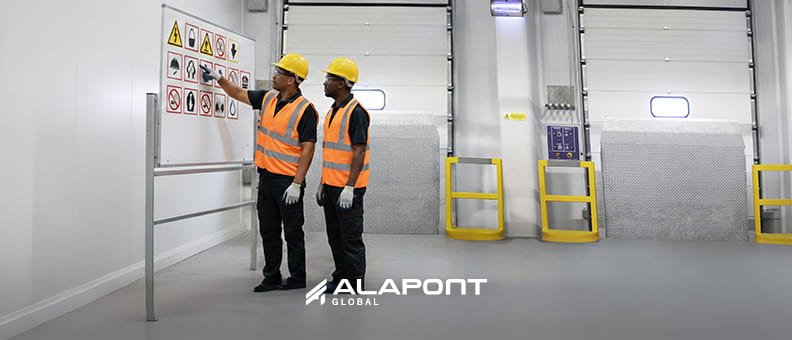
Prevention protocols in vehicle loading and unloading operations are technical and operational systems designed to mitigate critical risks such as falls from height and crushing hazards.
Proper implementation is essential to protect personnel and ensure compliance with UK Health and safety regulations, avoiding civil and criminal liability. To learn about all preventive measures in loading and unloading operations, consult our complete guide.
What makes a loading area safe?
In advanced logistics, the traditional loading dock has evolved into the loading bay, now regarded as an integrated risk unit. It is no longer merely an access point, it is a strategic structure where the synchronisation of mechanical and electronic components ensures the fluidity and safety of the entire supply chain.
A safe zone combines physical infrastructure with protection systems that minimise risks to both personnel and goods. The key elements for ensuring this protection include:
- Precise levelling: The use of a robust dock leveller allows for the adjustment of height between the bay and the vehicle, eliminating hazardous gaps or drops during forklift transit.
- Vehicle immobilisation: To prevent premature drive-offs or unexpected movement, loading dock vehicle restraints securely lock the lorry against the dock.
- Visual communication: The installation of specific dock signage and the driver and the operator, drastically reducing the risk of collisions or crushing accidents.
- Operational visibility: Adequate led loading dock guide lights ensures that the interior of the vehicle and the manoeuvring area are free from dark spots.
- Guidance and segregation: Safety accessories, such as bollards and handrails or loading dock wheel guides, direct the lorry’s reversal and provide physical protection for pedestrians.
Remember: infrastructure alone does not guarantee safety. Even with the best equipment, without clear procedures and regulatory compliance, the risk of accidents and legal liabilities remains.
Safety regulations in loading areas
Safety in loading operations in Spain is governed by a complex legal framework requiring continuous compliance monitoring. Lack of regulatory knowledge does not exempt you from criminal liability in the event of an accident.
Dock safety in the UK is based on three main pillars:
- Machinery safety (UKCA Marking)
- Provision and Use of Work Equipment (PUWER)
- Workplace health, safety and welfare
The primary regulatory framework is the Supply of Machinery (Safety) Regulations 2008. Any powered dock leveler is classified as machinery and must comply with these standards.
| Scope | Standard / regulation | Operational impact |
|---|---|---|
| Machinery Safety | BS EN 1398:2009 | Specific technical requirements for dock levelers. |
| Workplace safety | Workplace Regs 1992 | Minimum requirements for the safety of the working environment. |
| Equipment use | PUWER 1998 | Mandatory maintenance, inspection, and staff training. |
| Lifting operations | LOLER 1998 | Applies if the equipment is used for lifting loads. |
| EMC compliance | BS EN 61000-6-2 | Ensures electronic systems are immune to interference. |
To understand what UKCA marking (or CE marking where still applicable) implies, consider equipment as components requiring type testing and manufacturing controls.
Critical operational risks
Dock levelers represent high-risk points as they support heavy loads and continuous movement. Main hazards include:
- Crushing and shearing: Risk between the leveler and the vehicle.
Solution: Install rigid side panels and maintain a minimum 25 mm clearance from the vehicle chassis.
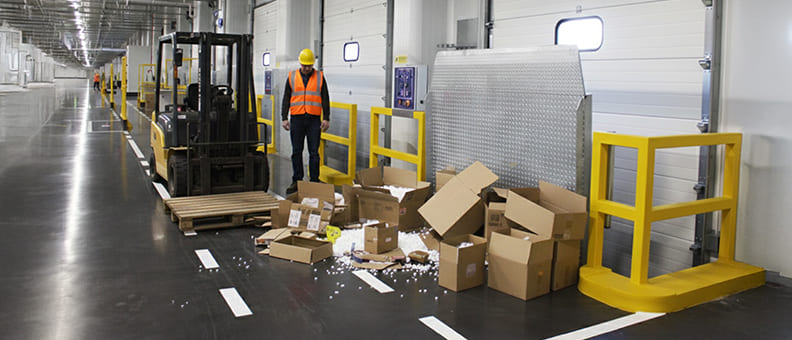
- Falls from height: Occurs due to open dock doors without a truck positioned.
Solution: Use barriers and clearly mark hazards with yellow/black safety striping.
- Load overturning: Excessive slopes may cause forklifts to tip.
Solution: Maximum slope must not exceed 12.5%. Platforms longer than 1.75 m must have a minimum torsional flexibility of 3% of their width.
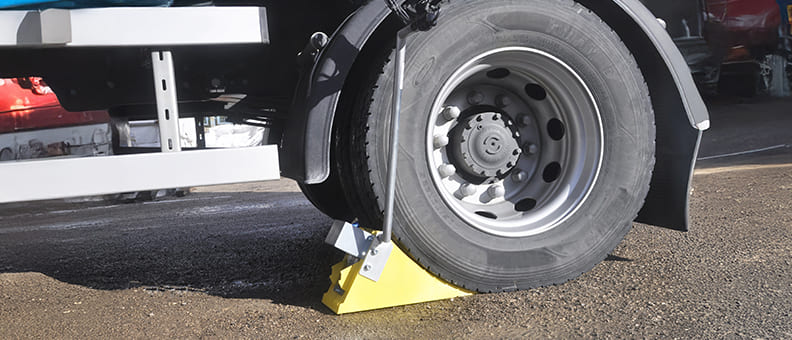
Vehicle restraint systems vs. traditional wheel chocks
Relying on manual wheel chocks to immobilise HGVs is unsafe. Premature vehicle departure (drive-off) is a leading cause of fatalities.
Advantages of truck restraint systems
- Secure locking: Prevents movement even if the driver accidentally accelerates.
- Active safety: Eliminates vehicle “creep” and prevents forklifts from falling into the dock pit gap.
- Integrated communication: Synchronises driver and operator actions via traffic light systems.
It is also advisable to integrate dock safety accessories such as steel bollards and wheel guides to center the vehicle and increase overall system effectiveness.
Legal obligations and responsibilities of the facility owner
Under the Health and Safety at Work etc. Act 1974, logistics safety follows a clear hierarchy of responsibilities:
- Manufacturer: Must design UKCA-certified equipment and provide technical manuals.
- Installer: Must verify operation in accordance with BS EN 1398 standards.
- Facility owner: Responsible for safe use, operator training, and equipment preservation.
- Maintenance provider: Must perform periodic inspections (Thorough Examination) as per manufacturer instructions.
Key obligations
- Manufacturer: Must design UKCA-certified equipment and provide technical manuals.
- Installer: Must verify operation in accordance with BS EN 1398 standards.
- Facility owner: Responsible for safe use, operator training, and equipment preservation.
- Maintenance provider: Must perform periodic inspections (Thorough Examination) as per manufacturer instructions.
Compliance with truck safety regulations and adherence to IFS Logistics quality standards are essential to maintaining world-class operations and avoiding severe penalties.
Maintaining operations through inspection and preventive maintenance
Preventive maintenance is an investment to avoid critical downtime. When analysing the impact of correct loading dock maintenance, it becomes clear that a hydraulic failure or undetected material fatigue can paralyse your facility and generate immeasurable costs due to loss of profit.
To ensure your installation meets all professional logistics standards, verify this technical checklist:
- Torsional flexibility: Confirm that the platform (>1.75) maintains its 3% torsional capacity.
- Visual signalling systems: Check that traffic lights and yellow/black markings are clearly visible (excluding the lips).
- Velocity fuse (Safety valve): Ensure the safety valve halts the platform in the event of an uncontrolled descent with more than $25\%$ of the rated load.
- Pit cleanliness: Remove debris that could obstruct the moving mechanisms or the cylinder.
- Condition of dumpers: To prevent structural damage to the facade, it is essential to install loading dock bump stops to replace any showing signs of degradation.
Frequently asked questions
Is UKCA marking mandatory for dock levelers?
Any powered dock leveler is considered machinery and must be safe, with a valid CE Declaration of Conformity, regardless of installation date.
Can I replace an automatic restraint system with wheel chocks?
Wheel chocks are better than less, but the best way to eliminate fall-from-height risk is by investing in a certified truck restraint system.
What liability do I have if a third-party driver is injured?
The facility owner/occupier is subsidiarily liable under the Occupiers’ Liability Act. You must ensure all safety systems and signage are functional before allowing operations to commence.
Transform operational risk into efficiency
Loading operations are the heart of your logistics flow, but also your greatest legal vulnerability. Integrating rigorous protocols and advanced restraint technology ensures compliance and transforms risk into efficiency.
Is your infrastructure ready for an HSE inspection?
Do not wait for an accident or a Prohibition Notice to compromise your business. Protect your team and avoid penalties by auditing your facility with experts.
Contact us today for a detailed assessment of your loading bay safety.
