
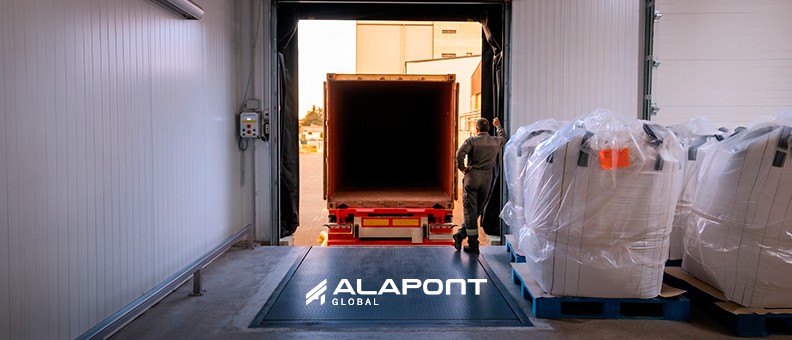
Cold chain disruption at the loading dock is one of the most critical risks in refrigerated logistics. This point is physically the weakest link, where the closed warehouse system opens to the outside environment.
Maintaining thermal integrity at this stage not only protects product quality, but also reduces energy costs, prevents temperature loss at logistics docks, and minimizes product waste that directly affects profitability.
How does thermal shock occur when a loading dock is opened?
Thermal shock is an immediate phenomenon: when the dock door is opened, an exchange of air masses takes place. Cold air, being denser, escapes through the lower part of the opening, while warm, humid outside air enters through the upper part.
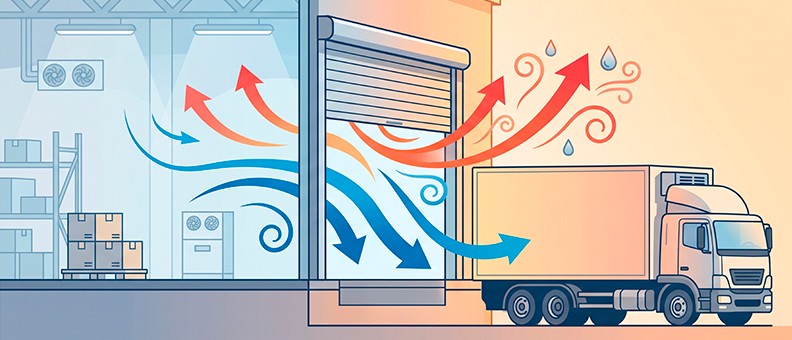
Consequences
- Instant temperature increase on the product surface.
- Activation of biological and chemical degradation processes before the truck even starts its route.
- Failures in cold storage loading docks that affect logistics efficiency.
To better understand this risk, it is essential to understand the importance of the cold chain, as every link must be perfectly coordinated.
How do moisture infiltration and frost affect efficiency?
Cold chain loss in loading areas does not only involve heat. Outdoor air brings humidity, which condenses when it comes into contact with cold surfaces, generating frost.
Direct impacts
- More frequent defrost cycles in industrial refrigeration equipment.
- Higher industrial energy consumption due to interruptions in product cooling.
- Risk of moisture affecting packaging and the hygienic safety of the dock pit.
How does the stack effect affect the cold chain at loading docks?
When the truck is positioned away from the dock wall, a gap is created that draws outside air toward the load. This forces the refrigeration unit to operate at maximum capacity, increasing fuel consumption and compromising product temperature.
A practical solution to prevent air leakage is the use of inflatable dock shelters, which hermetically seal the vehicle and reduce cold chain disruption in refrigerated logistics.
Why is waiting time during pre-loading dangerous?
During pre-loading, goods often leave the cold room and remain on the dock while paperwork is handled or pallets are organized.
This “idle time” allows the product to absorb latent heat, increasing its temperature before being loaded onto the truck.
For this reason, proper organization of staging areas is key to:
- Preventing cold chain disruption.
- Ensuring that products arrive at their destination in optimal condition.
How do thermal leaks affect the cold chain at loading docks?
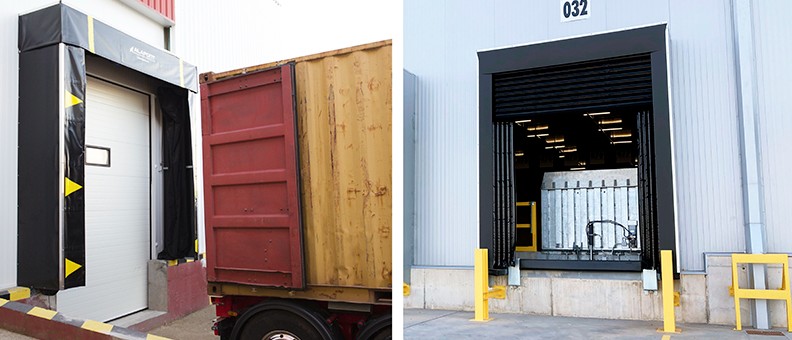
If dock shelters do not fit correctly, the loading dock acts as a thermal sieve. The refrigeration system runs continuously without being able to maintain the set temperature.
| Loading equipment | Advantage for the cold chain |
|---|---|
| Vertical dock leveler | Allows the truck to dock with its doors closed, opening them only inside the warehouse to prevent thermal exchange with the outside environment. |
| Telescopic lip dock levelers | Extend toward the vehicle, minimizing gaps in the contact area and enabling operation in controlled environments. |
| Inflatable dock shelter | Creates a high-performance insulation barrier by inflating against the rear of the truck, eliminating air gaps. |
What financial and sanitary risks are qenerated by dock failures?
Thermal inefficiency directly impacts three critical areas:
- Energy overcosts: The refrigeration motor operates excessively to compensate for thermal leaks.
- Product loss: Minimal temperature increases can encourage the growth of bacteria such as Salmonella or Listeria, or affect pharmaceutical products.
- Rejections and penalties: Failure to comply with regulations such as Spanish Regulation (EC) No. 852/2004 can lead to fines and loss of customer trust.
Frequently asked questions about the cold chain in loading areas
What temperatures are required for refrigerated and frozen products?
Refrigerated products generally require temperatures between 0°C and 10°C, with exceptions such as chocolate at 16°C, while frozen products must be kept below -18°C and may require temperatures as low as -30°C for long-term storage.
How does an inflatable dock shelter help reduce operating costs?
The airtight seal eliminates cold air leakage, reducing the workload of refrigeration systems and lowering energy consumption during transport.
What should I do if I detect a thermal anomaly during loading?
Activate the immediate response protocol: isolate the goods, measure the internal temperature with a probe, and check datalogger records to assess whether the product is suitable for use or must be discarded.
Ensure thermal control at your loading point
From thermal shock to the stack effect , dock-related risks are predictable and mechanical. The only way to turn a critical point into a strong link is to invest in industrial thermal insulation, dock automation, and real-time monitoring.
Carry out a preventive audit of your loading dock to identify thermal leaks and risk points. With a clear diagnosis, you can implement concrete actions that ensure cold chain integrity, optimize energy consumption, and protect product quality.
