
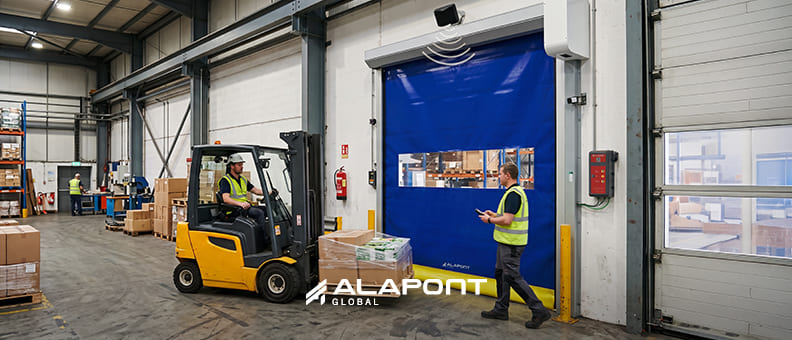
Contactless opening systems for industrial doors let you automate access without manually pressing a button. Using radar, induction loops, infrared sensors, photocells or TAG systems, you can speed up the flow of people and vehicles and reduce the number of contact points across your facility.
This technology is particularly useful when you’re running a warehouse, logistics centre or industrial plant with frequent traffic. The key is choosing the right detection system for the type of access point, the vehicles involved and how your operation actually works.
What problems does contactless opening solve?
When an industrial door relies on manual operation, each passage may require the operator to stop what they are doing to activate the opening. In high-traffic facilities, this action is repeated throughout the day.
In addition, the shared use of push buttons introduces contact points that may be unsuitable in certain environments where hygiene is particularly important.
Automatic touchless control systems address these situations by using detection technology to activate the door when required.
This allows you to:
- streamline the movement of people and vehicles;
- avoid manual door operation;
- reduce shared contact points;
- facilitate the loading and unloading of goods;
- control certain access points using authorised personnel.
The goal is not simply to automate a door, but to adapt its operation to the way you actually use the access point.
What are automatic contactless control systems?
They’re devices that activate an automatic industrial door without needing to touch a button. Depending on the technology used, they can detect motion, vehicles, metal objects, people or authorised credentials.
The detection system sends a signal to the door’s automation to start the opening cycle. The right technology depends on what you need to detect, which is why there’s no single system that works for every industrial access point.
What contactless opening systems are available?
There are several technologies currently available to automate access through an industrial door. The main ones are:
- Detection radar
- Induction loop
- Infrared touchless push button
- TAG system
- Selective detection photocell
Each one answers a different need.
How does a detection radar work?
Radar is designed for areas with a mix of machinery and personnel traffic.
In the solution developed by Alapont Global, laser-based technology allows the sensor to calculate the size, speed and trajectory of the object detected. This means the door only opens automatically when the system identifies that access is genuinely needed.
While the object remains within the detection zone, the system stops the door from closing during the pass. It’s a particularly useful option when you need to automate an access point with mixed traffic from both people and machinery.
How does an induction loop work?
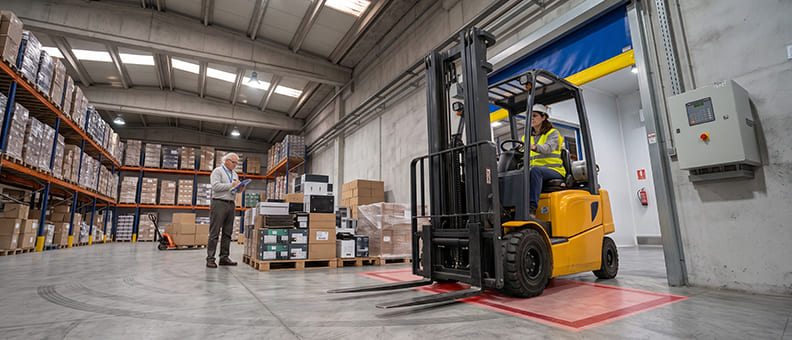
An induction loop uses a magnetic field installed beneath the floor to detect vehicles and metal objects.
When it picks up a forklift or another vehicle, it sends the signal needed to automatically open the door. This solution is particularly well suited to high-traffic areas and can also be used outdoors, since detection doesn’t rely on light reflections or non-metallic objects.
If your priority is automating the passage of vehicles and forklifts, the induction loop offers a solution built specifically for that scenario.
How does an infrared touchless push button work?
The touchless push button is designed for pedestrian use.
It uses active infrared technology to detect a quick hand movement in front of the device. Based on the information available from Alapont Global, it can detect this movement at a distance of up to 50 cm.
You don’t need to touch the button to activate the door. That makes it particularly suitable for facilities where you want to reduce physical contact, such as certain healthcare settings, hospitality, catering, and the food, pharmaceutical or logistics sectors.
How does a TAG system work?
The TAG system is designed for restricted-access areas.
The authorised person carries a coded card that communicates with a receiver installed next to the door. When they come within the corresponding range, the system triggers the automation. Depending on the model, that range can be anywhere between 1.5 and 5 metres.
You can also fit the device to a vehicle, allowing you to control access for both people and goods transport vehicles.
How does a selective detection photocell work?
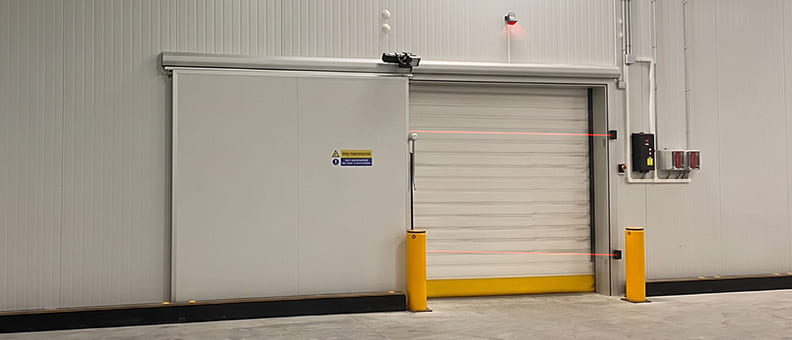
Photocells use infrared beams to detect anything crossing their detection line.
Beyond their use as a safety element, some configurations allow them to be used as an access control system as well. In Alapont Global’s solution, the system can be set up so the door only opens when a person reaches a specific point.
This stops the door being triggered simply because someone walks past the access point without actually intending to go through.
Which contactless opening system do you need?
The choice mainly depends on what the door needs to detect and how the access point is used.
| Facility need | System |
|---|---|
| Mixed machinery and personnel traffic | Radar |
| Frequent forklift traffic | Induction loop |
| Pedestrian-only access | Touchless push button |
| Restricted access | TAG system |
| Activation at a specific point | Photocell |
This distinction matters, because a system designed for vehicles doesn’t necessarily meet the same need as a pedestrian access point.
If you’re managing an access point with mixed traffic, radar lets you work with both people and machinery. If the access point is mainly used by vehicles and forklifts, the induction loop is built specifically for that kind of detection.
For a pedestrian access point where you want to avoid contact, the infrared push button offers a dedicated alternative. And if you need to limit activation to authorised users, the TAG system introduces identification via coded card.
Can these systems be fitted to an existing door?
Yes. Contactless opening systems can be applied to both existing doors and new installations.
How well they integrate depends on the characteristics of the door and the automation already in place. In certain projects, you can add detection technology to industrial high-speed doors or industrial sectional doors that are already part of the facility.
This means automation can be treated as an upgrade to an existing access point, rather than something that only applies to new-build projects. Before making any modification, it’s worth reviewing the door’s configuration and the components involved in its operation.
What should you consider before installing a contactless system?
Technology should not be chosen in isolation. First, you need to understand how the access point operates.
These are the main factors you should analyse:
- Type of user: people, forklifts or vehicles.
- Traffic frequency: occasional or continuous traffic.
- Type of access: open, restricted or exclusively pedestrian.
- Location: indoor or outdoor.
- Detection type: movement, metallic mass, position or credentials.
- Existing door: automation system characteristics and compatibility.
- Installation requirements: safety, speed and reduced physical contact.
This analysis helps avoid a common situation: installing a technically valid system that is not well suited to the actual operation.
The solution should first respond to how the access point is used and only then to the technology available.
What benefits do these systems bring to your facility?
Automating access can improve several aspects of your industrial operation.
Faster traffic flow
The door can be triggered without the operator having to stop and use a manual push button. In areas with frequent traffic, this keeps people and vehicles moving continuously.
Fewer contact points
Contactless systems remove the need to touch certain push buttons. This is particularly valuable when several people share the same access point and hygiene carries real weight.
Greater access control
Technologies like TAG let you limit activation to authorised personnel, adding an extra layer of control that’s especially useful for restricted access points.
Openings matched to actual traffic
Detection systems trigger the door based on presence or approach. The right configuration helps avoid unnecessary openings caused by people or movement that don’t acv
How does this relate to the safety of the door?
A detection system forms part of the door’s automation, but installing one needs to be assessed together with the rest of the components involved in how the door operates. This matters even more when you’re adding new devices to an existing door.
If you’re modifying an automatic door, you need to review the safety and compliance requirements that apply to industrial doors. Alapont Global’s own documentation sets out the requirements relating to industrial doors and their modification.
Automation, then, shouldn’t be treated purely as a matter of convenience. It needs to be properly integrated with the door and its safety systems.
Common questions before installing a contactless system
What’s the right system for a forklift?
The induction loop is designed to detect vehicles and metal objects via a field installed beneath the floor. Radar can also be used where there’s mixed traffic from machinery and personnel. The choice depends on which users you need to detect and how the access point works at your facility.
Which system suits a pedestrian access point?
The touchless push button is designed for pedestrian use and relies on active infrared to detect hand movement. It’s a particularly good option when you want to trigger the door without touching any surface, reducing contact points in environments where hygiene matters most.
Can a contactless system be used outdoors?
Yes, certain technologies are specifically suited to outdoor use. The induction loop, for instance, is recommended for these spaces because detection through the field installed beneath the floor doesn’t depend on light reflections or non-metallic objects passing in front of the door.
Can you control access using authorised personnel only?
Yes. The TAG system is designed specifically for restricted-access areas. It uses a coded card and a receiver fitted next to the door. Depending on the model, it can trigger when the credential is roughly between 1.5 and 5 metres from the receiver.
What happens if someone walks past a photocell?
A standard photocell can detect anything crossing its light beam. However, some configurations let you define a specific activation point. This way, the door can avoid opening simply because someone walks past the access point without intending to go through.
Conclusions on contactless opening
Automatic contactless control systems help speed up access and adapt each door’s opening to the type of traffic at your facility. The right choice depends on whether you need to detect people, forklifts, vehicles or authorised users.
That’s why, before installing any system, it’s worth assessing how the access point is actually used and which technology best matches that operation.
Looking for a contactless opening solution for your facility? The team at Alapont Global can help you define the right option based on your door, your traffic and your access requirements.
