
A poorly sized loading dock does not usually cause problems on the first day. The consequences appear over time: deformed dock levelers, breakdowns, downtime and less efficient logistics operations.
One of the most common mistakes is calculating capacity solely on the basis of the weight of the goods, without taking into account factors such as material handling equipment, frequency of use or the additional forces generated by movement during loading and unloading.
In this article, we explain the technical criteria we use to size a loading area safely and efficiently: how to calculate the actual capacity required, what gradient the dock leveler should have and which factors affect the performance and service life of the installation.
Why do loading docks fail?
In industrial loading and unloading projects, one of the most common problems we identify is that the dock equipment is not suited to the actual operating conditions.
In most cases, the cause lies in the design phase, when factors such as dynamic capacity, intensity of use, vehicle types or material handling equipment were not properly considered.
The main errors are usually related to:
- Insufficient capacity: Capacity is calculated only according to the weight of the goods, without considering the additional load generated by forklift trucks, pallet trucks or other material handling equipment.
- Ignoring dynamic capacity: A dock leveler does not operate under static load conditions. The movement of handling equipment generates additional forces on the structure.
- Failing to adapt the solution to actual use: A high-traffic installation requires a different level of strength and configuration from a loading dock used only occasionally.
- Designing without considering the complete operation: The gradient, vehicle manoeuvres and available space all affect day-to-day safety and productivity.
A poorly designed loading dock does not only cause breakdowns. It can also become a bottleneck that slows down the entire supply chain.
The objective should therefore not be simply to install a dock leveler, but to create a loading area designed to operate safely, quickly and efficiently throughout its entire service life.
Consequences of incorrectly sizing a loading dock
Incorrect sizing does not only affect the performance of the loading dock. It also has a direct impact on operating costs, productivity and the profitability of the installation.
An undersized system can lead to:
| Impact | Consequence for the company |
|---|---|
| Increased component wear | Higher maintenance and repair costs |
| Unexpected downtime | Disruptions to the logistics chain |
| Excessive structural stress | Reduced equipment service life |
| Incorrect gradients or capacities | Greater risk to operators and goods |
| Premature replacement | Lower return on the initial investment |
The decision should not focus solely on the initial equipment cost, but on the total operating cost over its entire service life.
Correct design from the outset helps reduce incidents, optimise operations and achieve a positive return on investment.
Static capacity vs dynamic capacity in loading docks
One of the most common mistakes when sizing a loading dock is using static capacity as the main reference instead of dynamic capacity.
Although both relate to the weight a dock leveler can support, they do not represent the same working conditions.
- Static capacity: The maximum load the dock leveler can support while stationary, without material handling equipment travelling across it.
- Dynamic capacity: The maximum load the dock leveler can support during operation, while forklift trucks, pallet trucks or other equipment move across it and generate additional stresses on the structure.
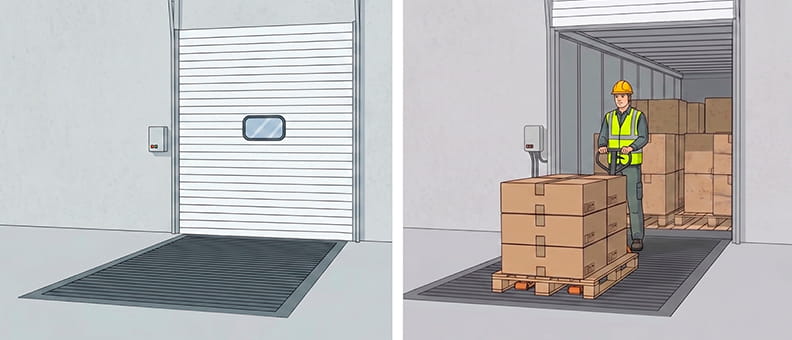
For example, a standard Alapont hinged-lip dock leveler has a static capacity of 9.000 kg and a dynamic capacity of 6.000 kg. This difference highlights the importance of sizing the installation according to actual operating conditions, as moving loads generate additional forces on the structure.
When calculating the required capacity of a dock leveler, dynamic capacity should be used as the main technical reference because it reflects the loads and stresses the equipment will withstand during daily operations.
How to calculate the actual capacity required for a dock leveler
Before carrying out the calculation, it is essential to understand the actual conditions of the installation.
At Alapont Global, we assess each project beforehand in order to size the required capacity according to the expected operation and ensure safe and efficient performance.
The main factors to analyse are:
- Types of vehicles using the loading area.
- Material handling equipment used during loading and unloading.
- Frequency of use of the dock leveler, whether occasional or intensive.
- Operating conditions, including the working environment and logistics process requirements.
With this information, the dock leveler can be correctly sized for safe and efficient operation.
To calculate the required dynamic capacity, add the following elements:
- Maximum goods weight: Always consider the heaviest load expected.
- Weight of the material handling equipment: Include the weight of the forklift truck, pallet truck or any other equipment that will travel across the dock leveler.
- Safety margin: Add an additional allowance to absorb impacts, braking forces and acceleration during operation.
Dynamic capacity calculation: Maximum goods weight + material handling equipment weight + operating margin according to intensity of use = required dynamic capacity
In addition to total weight, the intensity of use and traffic conditions must also be assessed. The more demanding the operation, the greater the safety margin should be to ensure performance and extend the service life of the installation.
Maximum gradient for loading and unloading trucks
The gradient of a dock leveler is a critical factor for both safety and operational performance. According to UNE-EN 1398:2010, the maximum acceptable gradient depends on the type of material handling equipment travelling across the platform.
| Handling equipment | Recommended maximum gradient |
|---|---|
| Wheeled container or manual pallet truck | 3% |
| Powered pallet truck | 7% |
| Electric forklift truck | 10% |
| Petrol- or gas-powered forklift truck | 12.5% |
Why is it important to calculate the gradient correctly?
The gradient should not be analysed as an isolated value.
The correct calculation must consider:
- Dock height: The difference between the loading dock floor level and the vehicle bed height.
- Available dock leveler length: This determines the final operating angle.
- Type of material handling equipment: Each type of equipment has different safety and manoeuvrability limitations.
- Frequency of use: Intensive operations require greater guarantees of strength and safety.
Incorrect design can cause:
- Difficulty of access for forklift trucks and pallet trucks.
- Impacts or loss of stability during loading and unloading.
- Increased wear on mechanical components.
- Unnecessary risks for operators.
How to calculate the required dock leveler length
To define the correct length, the following relationship must be considered:
Height difference between loading dock and truck / maximum permitted gradient = minimum dock leveler length
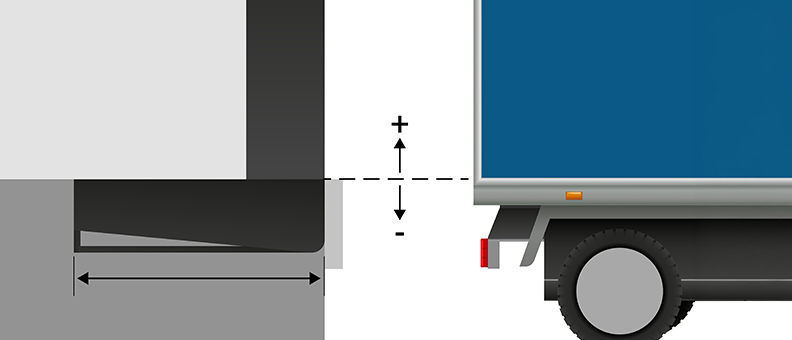
The greater the available length, the lower the gradient and the safer the transition between the loading dock and the vehicle.
Gradient is only one of the factors involved in loading area design. In our technical guide to warehouse design, we analyse the other criteria that should be considered when planning an efficient installation.
Key dimensions for designing an efficient loading area
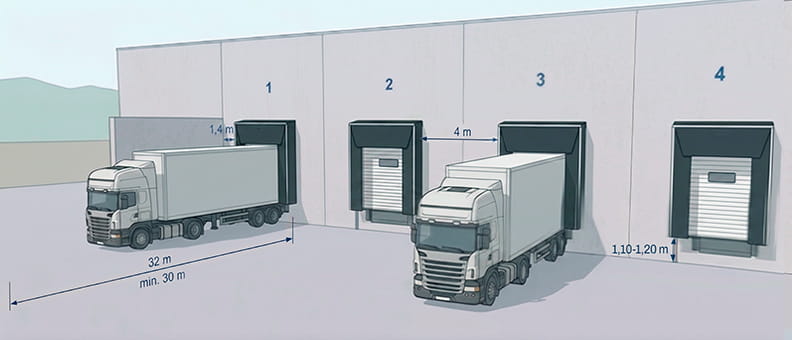
An efficient loading dock must do more than support the required load. It must also facilitate safe operations for vehicles, operators and material handling equipment.
Based on our experience, these dimensions should be defined during the design phase to prevent interference and ensure smooth operations from day one.
- Clear manoeuvring distance in front of the loading dock: 32 metres is recommended for large trucks, with a minimum of 30 metres where there is 2 metres of separation between vehicles.
- Spacing between loading docks: An optimum distance of 4 metres between loading dock centre lines is recommended to allow truck doors to open fully.
- Distance from walls: Where a loading dock is located close to a wall, at least 1,4 metres should be left to allow the truck doors to open correctly.
- Dock height: The standard loading dock height for trucks is generally between 1,10 and 1,20 metres.
When an installation receives vehicles with different loading heights, Alapont offers solutions such as the Smart-Dock loading platform, designed to adapt the loading point and maintain safe operations.
Common mistakes when designing a loading dock
Do not allow these planning mistakes to compromise your investment:
- Underestimating equipment weight: Many calculations consider only the pallet load, forgetting that an electric forklift truck can weigh as much as or more than the goods being handled.
- Ignoring travel speed: A travel speed of 2 to 3 km/h is recommended. Speeds above 10 km/h generate kinetic forces that can damage hydraulic cylinders.
- Insufficient lip overlap: The standard requires a minimum dock leveler lip overlap of 100 mm onto the truck bed.
- Failing to consider a telescopic lip solution: In installations where vehicles may not always be perfectly centred or where the loading position varies, telescopic lip dock levelers provide more precise control of the connection between the loading dock and the truck.
This improves safety, reduces risks and helps optimise loading and unloading times.
Frequently asked questions
How do I know which dock leveler my company needs?
The correct choice depends on factors such as maximum load weight, the type of material handling equipment used, frequency of use, loading dock dimensions and daily operating conditions. A prior technical assessment helps identify the most suitable solution for each installation, reducing the risk of overload problems and premature wear.
What information does a manufacturer need to calculate the correct solution?
To correctly size a dock leveler, the manufacturer needs key information about the installation and its operating conditions. This includes the height difference between the loading dock and the vehicle, required capacity, type of material handling equipment, daily traffic volume, and any specific operating or installation requirements that may affect the solution.
When is a telescopic lip dock leveler preferable to a standard solution?
A telescopic lip dock leveler can be preferable in installations where vehicle positioning may vary. Its design allows for a more precise connection between the loading dock and the truck, helping to improve safety and operational efficiency. At Alapont Global, these solutions are designed according to the specific requirements and conditions of each installation.
Strategic conclusion for your investment
Correctly calculating the load capacity and gradient of a dock leveler is essential to ensure safe, efficient and profitable operations. Proper sizing reduces breakdowns, minimises maintenance costs and extends the service life of the installation.
As we have seen, factors such as dynamic capacity, type of material handling equipment, frequency of use and loading dock characteristics must be analysed together in order to make the right decision.
If you need to validate these criteria for your installation, our technical team can help you define the most suitable solution for your operation.
